


 Français
 Deutsch
 Español

For businesses
Vehicle fleet audit and fleet inventory
Your fleet manager has left, the register no longer matches what is on the ground and nobody knows where the spare keys are. We carry out a physical inventory of your vehicles, record their condition and reconcile everything with your fleet register, on one site or several.
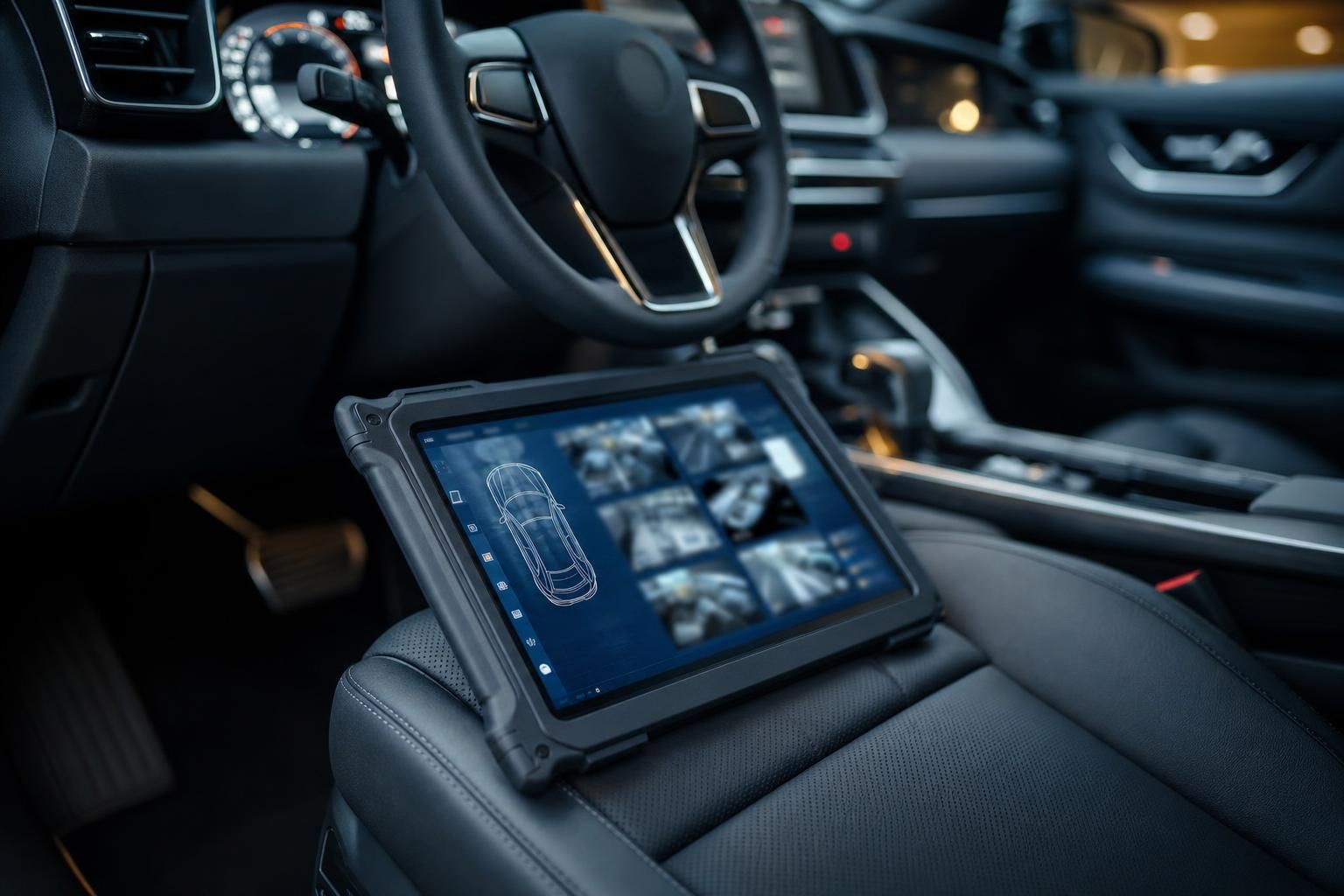
Illustrative photo
A physical and documentary audit of your fleet
LudExpress supports fleet managers in checking their vehicles: inventory, identification, visible condition, mileage, available documents and identification of discrepancies. An operational summary helps you direct corrective action.
The audit covers two areas, carried out together or separately depending on your needs:
- the physical audit, on site: each vehicle is seen, identified by its registration plate and its VIN, photographed and its mileage recorded, and its keys, equipment and on-board documents are checked off;
- the documentary audit, on paper: vehicle registration certificates (carte grise), rental contracts, French roadworthiness test (contrôle technique) reports and service records are reconciled with your fleet register.
The audit covers the visible condition of the vehicles and their documents. It is not a mechanical inspection: a warning light, marked wear or a suspicious noise is noted among the anomalies, so that your garage or an expert can examine it.
When the fleet manager has left without a handover
A company sees its fleet manager leave, and nobody has taken over the file in the meantime. The tracking spreadsheet is several months old, some cars have changed driver without it being recorded, roadworthiness tests are falling due and a spare key is missing at head office. Questions pile up on management’s desk: how many vehicles do we really have, who drives which one, which ones are due to be returned soon?
In this situation, we put the fleet back in order:
- document search: rental contracts, registration certificates, service invoices, roadworthiness test reports;
- photos and condition of each vehicle, recorded on site;
- who has which vehicle: allocation checked with staff;
- spare keys: kept at head office, with the driver or missing;
- reminders to staff about overdue services and roadworthiness tests;
- reminders about winter equipment to the drivers concerned, as 1 November approaches.
When a document is missing, we tell you who to ask for it: rental company, garage, test centre or former driver. At the end, you have an accurate picture of your fleet, vehicle by vehicle, and your next fleet manager starts from a sound base.

What we record on each vehicle
| Item checked | What we record |
|---|---|
| Identification | Registration number and VIN (vehicle identification number), compared with the registration certificate |
| Mileage | Odometer reading, with the date of the reading |
| Keys | Number of keys present, whether a spare exists and where it is kept |
| Equipment | High-visibility vest and warning triangle, spare wheel or tyre repair kit, charging cable, winter equipment depending on the area |
| Documents | Registration certificate, latest roadworthiness test report, service records |
| Condition | Photos of the bodywork and interior, tyres, warning lights on the dashboard |
| Deadlines | Next roadworthiness test, next service, end of rental contract |
The VIN, shown in field E of the registration certificate, can also be read on the vehicle, often at the bottom of the windscreen: comparing the two reveals documents swapped between two vehicles or an old data entry error.
Each vehicle receives a condition check on our LudExpress EDL app, with the same mandatory views as for a vehicle delivery, time-stamped and geolocated. Anomalies are flagged separately: undeclared damage, worn tyres, missing document, overdue deadline.
Reconciliation with your fleet register
The physical inventory of a vehicle fleet is mainly used to compare it with what the company thinks it owns. We start from your register in its current format, a spreadsheet or an export from fleet management software, reconcile our records with it and list the discrepancies:
- vehicle present on site but missing from the register, or the reverse;
- registration number or VIN entered incorrectly;
- driver different from the one recorded;
- actual mileage far from the declared mileage, or close to the mileage allowance set in the contract;
- missing keys, equipment or documents.
You receive these discrepancies vehicle by vehicle, with the corresponding condition reports. Your register can then be corrected on the basis of verified facts, and your decisions (lease return, repair, reallocation) are based on the actual condition of each vehicle. Our page on fleet management presents the operations that can follow.
Fleet audit deliverables
At the end of the audit, you receive:
- the inventory of vehicles, site by site, with their identification, mileage, keys and documents;
- the anomalies found, vehicle by vehicle: visible damage, missing items, discrepancies with the register, deadlines approaching or passed;
- authorised photographs, taken with your consent and in compliance with each site’s rules;
- a summary report, which sums up the condition of the fleet and ranks the corrective actions to be taken.
These documents can be shared as they are with your management, your rental company or your garage.
Preparing lease returns (LLD and LOA)
A lease return should be prepared several weeks before the due date. The audit lets you anticipate what the leasing company’s inspection will find: bodywork damage, scuffed wheels, stained seats, missing keys or documents, mileage compared with the contract. This leaves you time to have repairs done, gather the missing items or make decisions. The photos taken during the audit also serve as a point of comparison at the time of the return, as explained in our guide to vehicle condition reports.
Vehicles that still carry livery can go through our decal removal service, then be driven to the return point. The full process is described on the page vehicle return at the end of a long-term lease (LLD) or lease with purchase option (LOA).
Several sites, one inspection checklist
For a company with several sites, the fleet audit applies the same checklist everywhere. Results can be compared from one site to another, and everything is brought together in a single view of the fleet. Discrepancies specific to one site, such as keys kept at another branch or a vehicle lent without being recorded, then show up clearly. We operate in Île-de-France, in the Eure and throughout France subject to feasibility, organising our visits so that nearby sites are grouped on the same day.
A one-off audit or ongoing monitoring
A one-off audit meets a specific need: taking over a fleet, preparing a series of lease returns, a check before a contract renewal. Regular monitoring, on the other hand, follows the frequency you set. At each visit, we start from the previous record and flag what has changed: kilometres driven since the last visit, new damage, vehicles that have arrived or left, deadlines approaching. Your register stays up to date without you having to rebuild the inventory each time.
Driver reminders and winter equipment
A well-run fleet depends on drivers meeting deadlines. As part of regular monitoring, we remind staff whose vehicle is due for a service or a roadworthiness test, and we can organise these visits with our garage and roadworthiness test shuttles.
Every autumn, the winter equipment reminder is part of this monitoring. From 1 November to 31 March, in the mountain municipalities designated by prefectoral order (34 departments in the Alps, Corsica, the Massif Central, the Jura, the Pyrenees and the Vosges), a car or light commercial vehicle must carry snow chains or snow socks for at least two drive wheels, or be fitted with four winter tyres marked 3PMSF. Rule checked on service-public.gouv.fr on 12/11/2026. A sales representative whose round passes through one of these municipalities must therefore have one or the other on board, and the audit checks that they do.
What to include in your request
To prepare an accurate quote, please specify:
- the number of vehicles and their type: cars, vans, heavy goods vehicles;
- the number of sites and their addresses;
- whether a fleet register exists, and its format;
- the objective: inventory, fleet takeover, preparing lease returns, periodic audit;
- your deadline, for example a lease return date;
- access hours and the times when the vehicles are on site;
- the internal contact who will work with us.
Method and traceability
How is your job carried out?
The request
You choose your need and describe the vehicle, the journey or the site, online or by phone. Your request is given a reference.
The quote
We assess the request and send you a proposal stating the amount and the applicable terms, before any confirmation.
The pick-up
The driver arrives at the agreed time and carries out the LudExpress EDL condition report: required photos, mileage, fuel or charge level, keys and documents, signature of the person handing over the vehicle.
The delivery
On arrival, the same process compares the vehicle with its condition at departure. The recipient signs, and you receive the PDF report for the job.
880+
Vehicles delivered since August 2024
- Time given back to your teamsYour employees stay at their posts: our drivers move, deliver and return the vehicles.
- Documented handoversLudExpress EDL condition report at departure and on arrival, signed, with one PDF report per job. See the EDL
- A single point of contactFrom quote to delivery, reachable by phone or WhatsApp during the journey.
- An insured businessProfessional liability and motor liability insurance (RC professionnelle and RC circulation) with HISCOX; the applicable cover is specified in the quote.
On a quote basis, no public prices
Request a quote
Describe your need in two short steps. Each request is assessed in light of the vehicle, the journey and your constraints: you receive a tailored proposal, then we set the day and time together.
- Monday to Friday7.30 am to 6.30 pm
- Saturday7.30 am to 12.30 pm
FAQ
Frequently asked questions
Another question? Write to us or call us, we will answer you.
All frequently asked questionsDo the vehicles have to be taken out of service during the audit?
Each vehicle must be present and accessible with its keys while the photos and checks are carried out. We schedule our visits to keep disruption to a minimum: vehicles grouped in one car park, time slots when the vehicles are back at base, or visits spread over several days.
Can the audit be carried out without an existing fleet register?
Yes. We then start from the vehicles on site and the documents available, such as registration certificates, contracts and invoices, to rebuild the list of vehicles. This list becomes the basis of your new register.
How often should a fleet audit be carried out?
There is no single rule: it all depends on the size of the fleet, driver turnover and contract deadlines. Useful moments are a change of fleet manager, a wave of lease returns or a contract renewal, and some fleets are checked at fixed intervals, every quarter for example.
Can you audit vans or heavy goods vehicles?
Yes, the inspection checklist adapts to vans, specialist vehicles and heavy goods vehicles. If an HGV needs to be moved on site during the audit, it is driven by a delivery driver who holds the corresponding licence, subject to feasibility.
See also
 Fleet managementDelivery to employees, repatriations, servicing shuttles, returns and fleet inventories, carried out in the field for the fleet manager.
 LLD and LOA lease returnsCleaning, decal removal, keys and documents gathered, photographed condition report, then handover at the point agreed by the leasing company.